


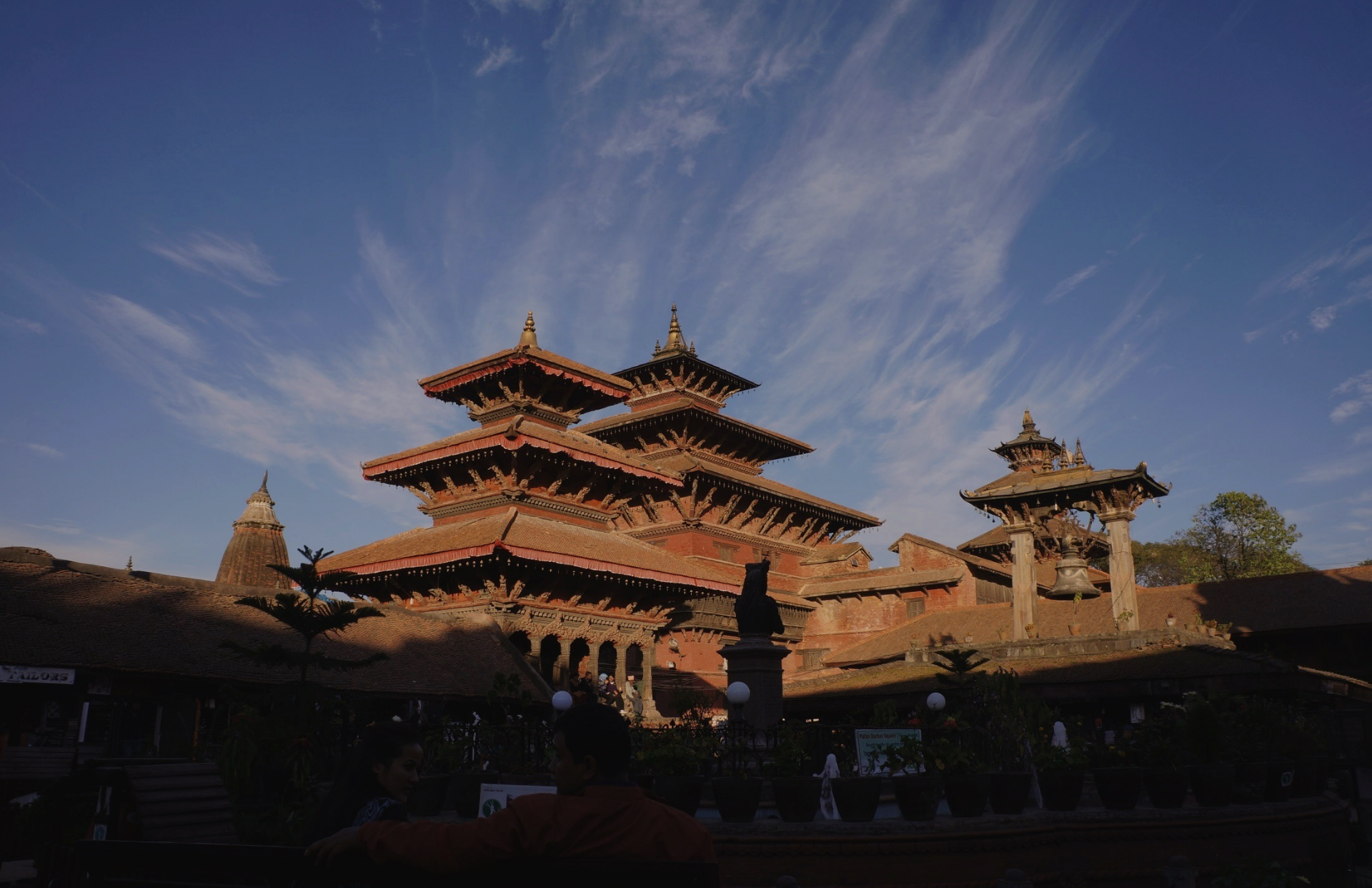
Location and Topography
Nepal is a small, landlocked country in South Asia, located between India and China. While it may not appear large on a map—covering about 56,000 square miles—it contains some of the most extreme and diverse geography in the world. For comparison, Nepal is slightly larger than the state of Illinois but has more vertical terrain than the entire Rocky Mountain range. Within a short 100-mile stretch, the landscape rises from the flat Terai plains at around 230 feet above sea level to the summit of Mount Everest, the world’s highest peak at 29,032 feet. This is a greater elevation gain than anywhere else on Earth. The country is divided into three main geographical regions: the Terai (southern lowlands), the Hill Region (central mid-hills), and the Mountain Region (northern Himalayas). Nepal’s topography creates diverse climates ranging from tropical in the south to arctic in the far north, making it home to ecosystems as varied as Bengal tiger habitats and alpine snow leopards. The Himalayan range, which stretches across Nepal’s northern border, includes eight of the world’s ten highest peaks—an astonishing fact considering the country’s modest size.
Latitude: 260 22″ North to 300 27″ North
Longitude: 800 04″ East to 88012″ East
Area: 147181 sq. km
Borders: North-Tibet, Autonomous Region of China; East, West, and South-India
Population (2024 est.): 31.07 Millions
Capital city: Kathmandu, 1.62 million
Monetary unit: Nepalese rupee
Internet TLD: .np .नेपाल Religion: 81.3% Hinduism, 9% Buddhism, 4.4% Islam, 3% Kirant, 1.4% Christianity, 0.4% Animism, 0.5% Irreligion
History of Nepal
Nepal’s recorded history spans over 2,500 years, though human settlements in the region date back at least to the Neolithic age. Ancient texts such as the Mahabharata mention Nepal, and archaeological evidence places the Kathmandu Valley as a center of civilization as early as the 1st millennium BCE. The Licchavi dynasty (circa 400–750 CE) established many of Nepal’s earliest stone temples and water systems, some of which are still functional. In the 12th century, the Malla kings ruled and ushered in a golden age of art and architecture, particularly in the Kathmandu Valley. Modern Nepal was founded in 1768 when King Prithvi Narayan Shah of the Gorkha Kingdom unified various small principalities into a single state. Unlike most South Asian nations, Nepal was never colonized, although it fought the British East India Company in the Anglo-Nepalese War (1814–1816), resulting in the Treaty of Sugauli, where Nepal ceded about one-third of its territory, including parts of present-day India. In the 20th century, Nepal was ruled by a hereditary monarchy, followed by a period of absolute monarchy until the 1990 People’s Movement led to constitutional reforms. A second movement in 2006 led to the end of the monarchy entirely in 2008, transforming Nepal into the Federal Democratic Republic it is today.
Governance System
Nepal’s political system today mirrors many democratic institutions familiar to Americans. It has a President as the ceremonial head of state and a Prime Minister as the head of government, akin to systems seen in countries like India or the United Kingdom. Nepal adopted its new democratic constitution in 2015, following years of political instability and a decade-long Maoist civil war that ended in 2006. The country is now organized as a federal republic, divided into seven provinces, each with its own local government and legislature. Nepal’s national Parliament is bicameral, consisting of a House of Representatives and a National Assembly, and general elections are held every five years. The voting age is 18, just like in the U.S. Despite the new system, Nepal’s political landscape remains turbulent, with frequent changes in leadership—more than a dozen Prime Ministers have taken office since the monarchy ended in 2008. The country is also secular by constitution, a significant change from its prior designation as a Hindu kingdom, reflecting a broader commitment to inclusion and democratic values.
Society and Culture
Nepal is one of the most culturally diverse countries in Asia, despite its relatively small size. Home to over 30 million people (roughly equal to the population of Texas), it includes more than 120 ethnic groups and 123 officially recognized languages. The largest ethnic groups include Chhetri, Brahmin, Magar, Tharu, and Tamang. The country’s population is about 81% Hindu, 9% Buddhist, 4.4% Muslim, and 3.1% Christian and other religions. While Hinduism is the majority, Buddhism is deeply woven into the cultural fabric, particularly in the Himalayan region. The co-existence of Hinduism and Buddhism is especially visible in the Kathmandu Valley, where temples and stupas often sit side by side. Nepal is also home to ten UNESCO World Heritage Sites, including the cultural ensembles of Kathmandu, Patan, and Bhaktapur, as well as important religious landmarks like Pashupatinath Temple and Swayambhunath (the “Monkey Temple”). Many of these monuments are over a thousand years old, standing as symbols of Nepal’s spiritual legacy and sophisticated craftsmanship. Nepali society is deeply communal, with festivals, rituals, and hospitality playing central roles—values that many Americans may find resonate with small-town and faith-centered communities in the U.S.
Economy
Nepal’s economy is among the smallest in South Asia, with a GDP of about $40 billion as of 2023—comparable to the U.S. state of Vermont. It is considered a low-income country, but it is rich in natural and cultural capital. Agriculture employs about two-thirds of the population, though it contributes only around 25% to the GDP. One of the major economic drivers is remittance: nearly 3.5 million Nepalis work abroad, primarily in the Gulf countries, Malaysia, and India, sending home over $9 billion annually—equal to nearly 25% of the national GDP. This makes Nepal one of the top five countries in the world in terms of remittance-to-GDP ratio. Tourism is another cornerstone of the economy, contributing about 7% to GDP and employing hundreds of thousands of people. In 2019 (pre-COVID), Nepal welcomed 1.2 million international visitors. Tourists come not only for trekking and climbing but also for spiritual retreats, wildlife safaris, and cultural experiences. Nepal’s potential for hydropower is also significant—it has the capacity to produce over 80,000 megawatts of electricity—but only a fraction is currently being utilized. As Nepal modernizes, investments in infrastructure, education, and energy are key growth areas.
Birthplace of Buddha and Mount Everest
Two facts about Nepal stand out immediately to most Americans: it is the birthplace of Buddha and home to Mount Everest. Siddhartha Gautama, who later became the Buddha, was born around 623 BCE in Lumbini, located in southern Nepal near the Indian border. Lumbini is now a UNESCO World Heritage Site and pilgrimage center, visited by Buddhists from all over the world, including from the U.S., where Buddhism has seen a growing following in recent decades. The site contains ancient ruins, a sacred Bodhi tree, and the Maya Devi Temple, marking the exact spot of Buddha’s birth. Mount Everest, or “Sagarmatha” in Nepali and “Chomolungma” in Tibetan, is perhaps Nepal’s most iconic symbol. It was first summited by Sir Edmund Hillary of New Zealand and Tenzing Norgay, a Sherpa of Nepal, on May 29, 1953. Today, Everest is a major destination for climbers from around the globe, including hundreds of Americans annually. Over 6,000 people have summited Everest to date, and the mountain continues to captivate adventurers, scientists, and filmmakers alike. Together, Lumbini and Everest represent Nepal’s profound contributions to both spiritual and natural heritage on a global scale.


Political Map of Nepal
The political map of Nepal outlines the country’s administrative divisions, including seven provinces and 77 districts. It highlights Nepal’s borders with China to the north and India to the south, east, and west.

